Diesel at $3 a Litre: What the Fuel Crisis Means for Mining, Construction, and Fleet Operations
Grid Rig Australia
Australia's fuel crisis has exposed a structural vulnerability that existed long before the strikes on Iran. For operators burning billions of litres of diesel a year, the case for reducing dependency just became impossible to defer.
On 3 March 2026, Melbourne's terminal gate price for diesel sat at 165.6 cents per litre. Three weeks later, it hit 295.1 cents. Sydney diesel has since topped $3.22 per litre, with regional stations recording even higher. More than 608 service stations nationally have reported fuel outages. The federal government has described the situation as a national crisis and adopted a four-stage National Fuel Security Plan, with Australia currently at Level 2.
But this isn't really a story about the war in Iran or the price of Brent crude. It's about what happens when an industrial economy imports 90 per cent of its refined fuel, holds fewer than 40 days of reserves, and has no meaningful contingencies for disruptions.
The vulnerability was always there, the Strait of Hormuz just made it visible.
The structural exposure
Australia consumed approximately 33.5 billion litres of diesel in 2025. Diesel accounts for 56 per cent of the country's total oil product consumption, powering light vehicles, freight trucks, and mining equipment. The mining sector alone burns 9.6 billion litres per year, producing 22 million tonnes of CO2-equivalent emissions. In agriculture, diesel represents 84 per cent of on-farm energy consumption.
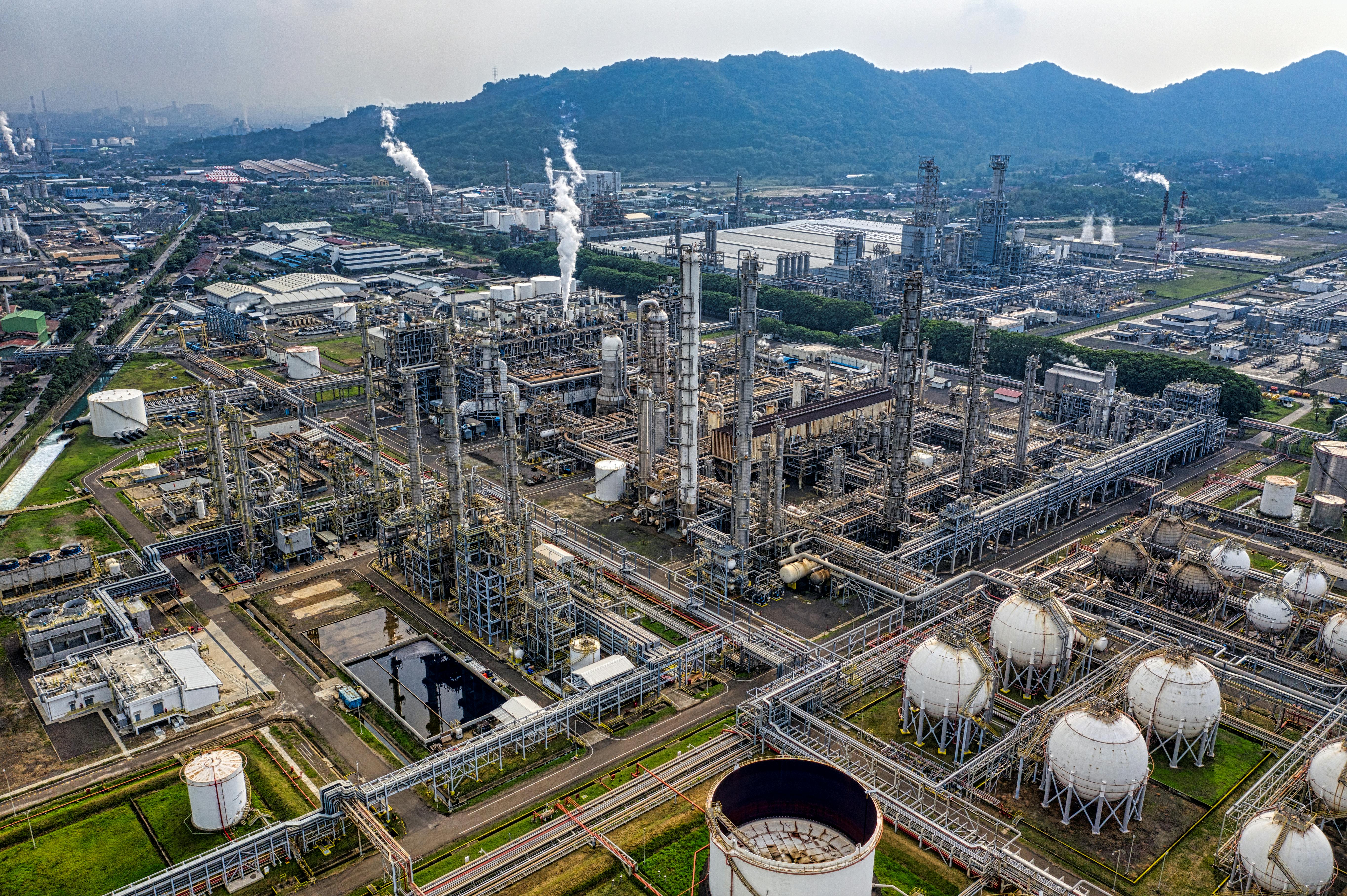
Two refineries remain operational: Ampol's Lytton facility in Brisbane and Viva Energy's Geelong plant. Together they meet less than 20 per cent of national demand. The rest arrives by tanker, primarily from South Korea, Singapore, and Malaysia. South Korea alone supplies roughly 120,000 barrels of diesel per day, approximately half of Australia's diesel imports, and its government has now capped refined product exports.
Australia has been non-compliant with the IEA's 90-day fuel reserve requirement since 2012. Before the crisis, reserves sat at roughly 36 days of petrol and 34 days of diesel, the highest levels in 15 years but still well short of international obligations. The government has since released 762 million litres from emergency reserves, temporarily lowered fuel quality standards to redirect export-grade fuel into the domestic market, and halved the fuel excise for three months from 1 April, a measure costing the budget $2.55 billion.
These are crisis responses, not structural solutions. The excise cut expires on 30 June. The supply agreement with Singapore is a stopgap. And industry analysts have flagged that elevated prices could persist for 12 to 36 months regardless of how the conflict unfolds.
What this means at site level
For the mining, construction, and fleet operators who make up the bulk of Australia's industrial diesel consumption, the price spike is an immediate hit to operating costs.
Fortescue consumed 450 million litres of diesel in FY24, accounting for 51 per cent of its Scope 1 emissions. At pre-crisis prices, that fuel bill was already enormous. At current terminal gate prices, the cost increase for a single large mining operation runs to hundreds of millions of dollars annually. Scale that across the sector's 9.6 billion litres and the exposure becomes clear.
Freight operators are already reporting cost increases of 20 to 30 per cent flowing directly to consumers. Regional agricultural operators, many of whom cannot secure diesel supply at all, face the prospect of unharvested crops and idle machinery at the worst possible time, coinciding with critical sowing seasons.
The fuel tax credit scheme, which returns 52.6 cents per litre to off-road diesel users under normal conditions (temporarily halved alongside the excise cut), provides some buffer. But the IEEFA has found that the mining industry receives $4.5 billion a year in diesel rebates, accounting for 47 per cent of Australia's $9.6 billion annual fuel tax credit spend, with credits flowing unconditionally regardless of emissions performance. The scheme effectively subsidises the continued use of diesel while creating a structural disincentive to invest in alternatives.
The electrification equation has changed
None of this means diesel is going away. It remains essential to mining, freight, agriculture, and construction, and will for years. Electrification of heavy industry is a decade-long transition, not a crisis response.
But the crisis has fundamentally changed the urgency of that transition. The business case for electrification has always centred on emissions reduction and long-term operating cost savings. It now includes a third factor: supply security. Electricity is generated domestically. Diesel is not.
The technology is further along than many operators realise. Fortescue has ordered 360 autonomous battery-electric haul trucks from Liebherr as part of a $4 billion electrification program targeting real-zero terrestrial emissions by 2030. The company reports its electric fleet is already delivering $300 to $400 million in annual fuel savings. BHP has introduced Australia's first Cat 793 XE battery-electric haul trucks at its Jimblebar mine. Electric excavators, loaders, and underground vehicles are operating on Australian sites today.
Yet the broader industry has been slow to commit. The IEEFA notes that apart from Fortescue, major miners are not implementing diesel displacement at scale before the 2030s. Actual diesel emissions in mining are rising at 6 per cent per year, even as government forecasts project a 4.5 per cent annual decline. A crisis that puts diesel above $3 a litre and exposes the fragility of the entire supply chain may be the catalyst that closes that gap between intention and action.
The charging infrastructure gap
The biggest barrier to deploying electric equipment in mining and construction has never been the machines. It is getting charging infrastructure to where the work happens. Grid connections for commercial sites take 18 to 24 months. Most mine sites and construction projects are remote, temporary, or both. Permanent charging infrastructure cannot be justified for a drilling contract that lasts six months or a construction project that moves on in a year.
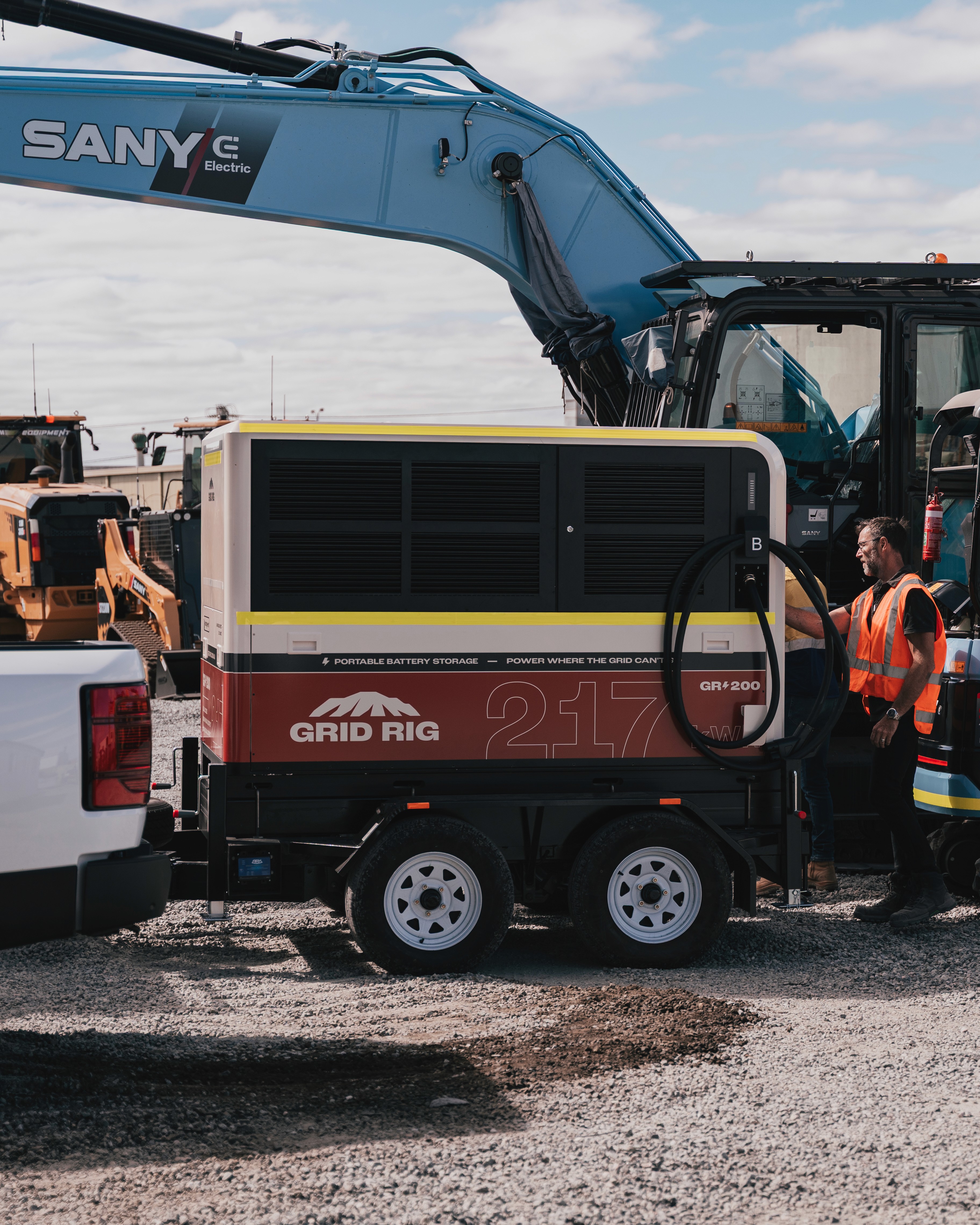
Mobile battery energy storage and charging systems address this constraint directly. Modern units provide 100 kWh to 2 MWh of storage with DC fast charging up to 180 kW. They require no grid connection, no permits, and no construction lead times. A unit deploys in hours and relocates when the operation moves. For contractors and fleet operators looking to begin electrification now rather than waiting years for permanent infrastructure, mobile charging is the practical starting point.
Looking ahead
The government's crisis interventions, from excise cuts to reserve releases to the four-stage National Fuel Security Plan, are buying time. But they are demand-side measures with expiry dates. The excise cut runs to 30 June. The lowered fuel quality standards last 60 days. And the underlying cause, a structural dependency on imported diesel with no meaningful domestic alternative at scale, remains unchanged.
Whether the conflict escalates further or resolves in coming months, Australia will still import 90 per cent of its refined fuel. Reserves will still fall short of international benchmarks. And the next disruption, whether geopolitical, logistical, or climate-related, will produce the same result.
The operators who use this moment to accelerate their transition away from diesel dependency will not just be reducing emissions. They will be building operational resilience against a risk that has now moved from theoretical to demonstrated. Every kilowatt hour of energy generated and stored domestically is one less litre of diesel that needs to arrive by tanker from the other side of the world.
That is no longer an environmental argument. It is an operational one.
Grid Rig provides mobile energy storage and EV charging solutions for mining, construction, and industrial operations across Australia. Get in touch to discuss your requirements.